"Curious and Curiouser!" exclaimed Alice.
Curiosity is a core value for students at Ivanhoe Girls’ Grammar School and beyond. Curious to discover both the world, and their place in it.
For Catherine Lobbe (Class of 2015), she has found her place a rather 'curious' one; volunteering at Sanaga Yong Como Rescue Centre in Cameroon, working with chimpanzees!
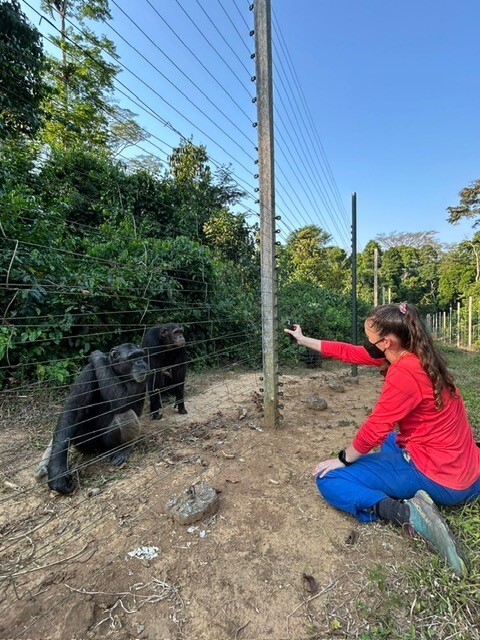
Why volunteer at the Chimpanzee Rescue Centre?
After school, I spent seven years at university, and then I went into the workforce for three years. COVID had meant that I was not able to complete an overseas placement as is commonly done, so I decided to give myself a year to spend travelling and a chance to revaluate my career options.
I spent time travelling in Central and South America, which was fantastic, but I wanted to do something more meaningful. I had a friend who is a vet and is on her second six-month stint at the Rescue Centre.
The chimpanzees are those rescued from the illegal ape meat trade, or habitat destruction, or from poachers who are wanting to sell infants to a lucrative foreign trade. Often they have killed the mother to get the infant. I was also attracted by the focus on sustainability and community empowerment at the Centre.
The Centre is in its 27th year and is moving to a model of using fewer international staff; they have just hired two Cameroonian vets. There are about 35 local workers, some who have been there for 25 years.
Through paying a decent wage, contributing to the local economy, providing access to education and healthcare, the sanctuary tries to improve the quality of life for those in the surrounding villages, and provide conservation education.
Where is the sanctuary, what are the daily living conditions, and what language do they speak?
Sanaga Yong is in the eastern section of Cameroon, Africa, and is located in the Mbague forest, which is 24km from the nearest town of Belabo. It is an area of precious rainforest.
It is in the francophone area of Cameroon, however most people speak at least two local dialects and French is their third or fourth language. My Year 12 French was rusty, but is definitely improving!
Volunteers live onsite with vets and other staff. Electricity is provided through solar panels and reserved for essential items such as radios for communication. We live in basic concrete cabins and have a shared kitchen.
We go to Belabo once a fortnight to get supplies for camp. We get fresh fruit from local villages, and water from a bore which is pumped up to camp by a generator. We have bucket showers, long drop toilets, and we hand wash our clothes. We have one spot in the forest where we can sometimes get internet and use WhatsApp.
I’m here in the dry season with temperatures ranging from 25°C to 30°C during the day, and about 20°C at night. The wet season would be more difficult conditions.
What are you doing as a volunteer?
I prepare meals for the chimps. They eat four times a day and eat a variety of fruits, vegetable, leaves and grains. They also find and eat insects, leaves and wild fruits. To prepare the meals I have to clean all the fruit and count out pieces for 76 chimps. Some chimps have special diets also.
I also prepare ‘enrichment’ for the chimps. Some chimps have restricted movement during the day because of medical or behavioural problems, so to stop them getting bored we prepare various activities for them throughout the day. This includes coloured pencils and paper, soapy water in a bucket, food inside various containers that are difficult to get out, a collection of different wild fruit, leaves, seeds, or other similar activities.
Have your medical skills been useful?
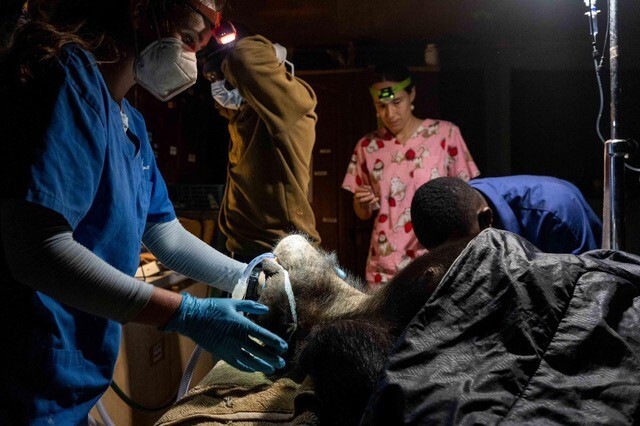
Almost everyday I use some medical skills. I can support Hannah, the vet, during surgeries as there is no nursing support. I can help her monitor the anaesthetic so that she can spend time during operations teaching and supervising local vets.
Healthcare is hard to access here and very expensive. The local hospital is 24kms away in Belabo, and most people don’t have cars or bikes. Medical services are very limited. The sanctuary supports their workers and families to access health care if needed, but to be able to provide basic first aid and medical care can save the families a lot of money.
How do you recognise the chimpanzees?
They all have names and individual personalities which are well-known to the caregivers. Caregivers are staff working with certain chimps and enclosures. Some of the caregivers have been working with the chimps for over 10 years and have special relationships with them, and can tell you all their likes and dislikes. Since getting here I have learnt to identify all the chimps and interact with a few particularly friendly chimps. They are wild animals with a dangerous potential which can never be ignored.
What have you learnt about yourself and about the chimpanzees?
I have learnt that my medical skills do have application outside the usual medical system.
I have also learnt about the interaction between chimpanzees and humans. One normal behaviour for chimps is grooming. This when they take turns looking at each other’s skin and squeezing/picking at any abnormalities. This is beneficial for squeezing out insects and cleaning wounds. When chimpanzees are comfortable with certain humans, they will try to groom them, or offer their arm to be groomed! When grooming humans, they love picking at pimples, belly buttons and they love playing with zips and pockets.
Sometimes if a chimp has hurt themselves, they will present it to the vets or caregivers to be looked at. Chimps here love cleaning – each day their sleeping quarters get cleaned while they are out in their enclosure, but if you give them a mop or a cloth, and some water when they come back, they will copy what they have seen!
Do you have a special chimpanzee story to tell us?
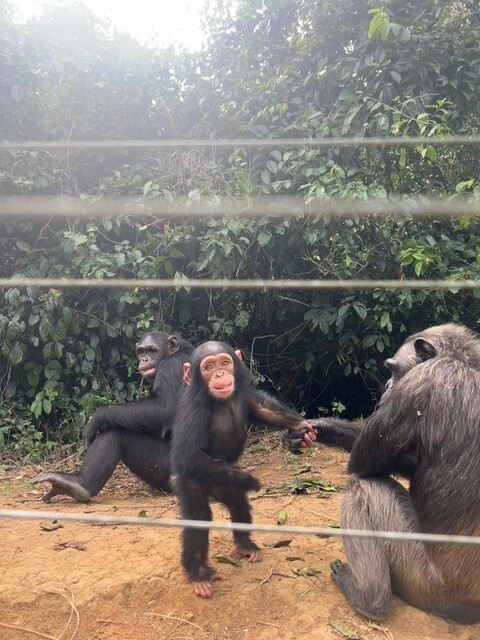
Amaia was born at the sanctuary due to birth control failure (all the chimps at the sanctuary have to be on birth control but occasionally accidents happen – three since 1999!).
Amaia's mother Carla is raising her really well despite the fact that Carla’s mother was killed for the illegal bushmeat trade, and therefore Carla never learnt any parenting skills.
It takes a whole family of chimps to raise a baby. Amaia can often be seen riding for fun on Aunty Margot’s back, having a tickle fight with Aunty Cecile, playing with Aunty Anita’s feet, chasing Aunty Selma and jumping on dad, Kanoa. When there is any conflict or concern in the group Carla and Margot take Amaia deep into the jungle, away from any danger.
 Book a Tour
 Enrol Online
 Prospectus